
What Is Titanium Dioxide
Titanium dioxide is an inorganic compound with the chemical formula TiO2, and its appearance is white powder. It is non-toxic, best opacity, best whiteness and brilliance. TiO2 has many excellent properties, such as photocatalysis, semi-permanence, hydrophilicity, acid and alkali resistance, responsiveness to different visible light, weather resistance, and oxidation resistance. So TiO2 powder is widely used in plastics, coatings, paper, printing ink, chemical fiber, rubber, cosmetics and other industries.
Titanium dioxide products are generally classified into rutile and anatase grades based on crystal structure, and are produced through either the sulfate process or the chloride process. Among them, rutile titanium dioxide pigment is the preferred choice for demanding applications due to its superior weather resistance, opacity, and long-term performance.
Product Introduction of Titanium Dioxide Rutile & Anatase
TiO2 titanium dioxide has two main structures: titanium dioxide rutile (R type) and titanium dioxide anatase (A type). They both have good chemical stability at room temperature and are insoluble in water, fat, most dilute acids and alkalis. However, in long-term outdoor environments, due to the more stable crystal structure of rutile titanium dioxide, it has a stronger ability to resist chemical erosion in the environment and its chemical stability is slightly better than that of anatase TiO2.
(1) Rutile TiO2 pigment has a compact structure, is relatively stable, and has low optical activity, so it has good weather resistance. At the same time, rutile TiO2 has high hiding power and color reduction power, so it is widely used in high-end fields such as coatings, plastics, inks, papermaking, rubber, chemical fibers, cosmetics, etc.
(2) Compared with rutile TiO2, anatase type has relatively lower hiding power and whiteness, but has good dispersibility and is easy to process. And anatase TiO2 is mainly used in low-end plastics, architectural coatings, paper and other fields.
(3) The melting point of anatase titanium dioxide pigment is as high as 1500℃, but under high temperature environment (above 400℃), it will gradually transform into rutile type and gradually turn yellow. While the melting point of rutile TiO2 is about 1850℃, and it has stronger thermal stability and is not prone to crystal transformation and color change at high temperature.
Hot-selling models: R-996,BLR-852,BLR-883,BLR-885,BLR-886,BLR-887,BLR-891,BLR-895,BLR-896,BLR-698,BLR-699,LR-108, LR-952,LR-961,LR-972,LR-982,TR52,TR5.
| Painting | Plastic | Prinking ink | Paper Making | ||||||
|---|---|---|---|---|---|---|---|---|---|
| Products | Indoor building paint | Outdoor building paint | Industrial coating | Master batch | Outdoor plastic | Table printing ink | Inner printing ink | Surface coating | Laminated paper |
| BLR-895 | optimization | optimization | general | ||||||
| BLR-896 | general | optimization | optimization | general | |||||
| BLR-891 | optimization | optimization | |||||||
| BLR-886 | optimization | ||||||||
| BLR-852 | optimization | optimization | |||||||
| R-996 | optimization | optimization | general | general | |||||
| BLR-698 | optimization | general | optimization | general | general | general | |||
| BLR-699 | optimization | optimization | general | general | |||||
| LR-972 | general | optimization | optimization | general | general | ||||
| LR-961 | general | optimization | general | ||||||
| TR52 | general | optimization | optimization | ||||||
| LR-982 | general | general | optimization | general | |||||
| TR53 | general | general | general | optimization | |||||
| LR-108 | optimization | ||||||||
| BLR-688 | optimization | ||||||||
| LR-952 | optimization | optimization | |||||||
| BLR-501 | |||||||||
| BLR-601 | |||||||||
Popular models: R-298,R-248,R-249,R-258,CR340,CR350
Main models: R-5566,R-298,R-902,R-5567,R-5569
Models: R-213,R-215,R-216,R-217,R-219,R-2196,R-2196+,R-2219,R-231
Main Uses of TiO2 Pigment
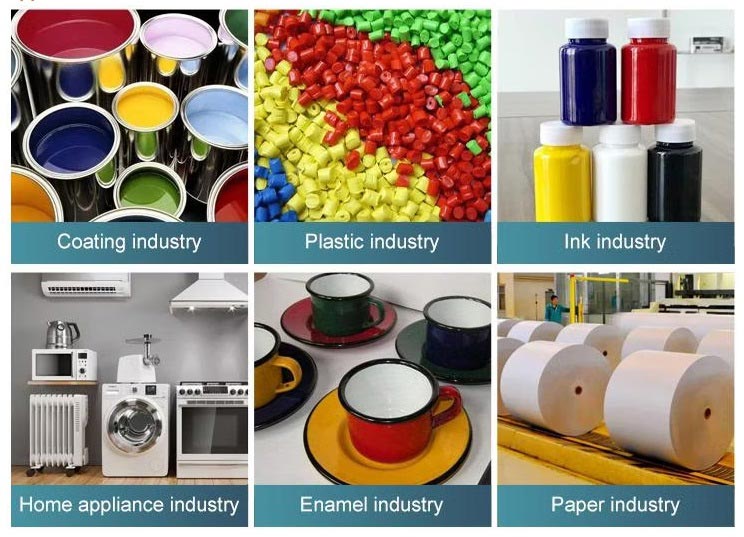
Titanium dioxide (TiO₂) pigment is an important inorganic compound with a variety of unique performance characteristics that make it widely used in many fields. Here are some of the main performance characteristics of titanium dioxide:
(1) High refractive index. TiO₂ powder has a very high refractive index, which makes it an excellent optical material. In areas such as coatings, inks and plastics, it can provide excellent hiding power and color saturation.
(2) Chemical stability. The product is stable to most chemicals at room temperature, including acids, bases and many organic solvents. This gives it a long service life in applications such as coatings, pigments and catalysts.
(3) Photocatalytic properties. Titanium dioxide powder exhibits excellent photocatalytic properties under ultraviolet light. This property makes it widely used in areas such as environmental purification (such as degrading organic pollutants and killing bacteria) and energy conversion (such as solar cells).
(4) Ultraviolet absorption. TiO₂ pigment can strongly absorb ultraviolet rays, so it is often used as an active ingredient in sunscreens and other sun protection products. It can effectively prevent ultraviolet damage to the skin and reduce skin aging and other related health problems.
(5) Semiconductor properties. This chemical is a wide bandgap semiconductor material with excellent electrical properties. It can be used as a key material in fields such as solar cells, sensors and photoconductors.
(6) Thermal stability. Titanium dioxide (TiO₂) can maintain stable performance even at high temperatures, which makes it widely used in fields such as high-temperature coatings, ceramics and glass.
(7) Non-toxic and harmless. It is a non-toxic and harmless compound that has a wide range of applications in fields such as food, cosmetics and medicine.