
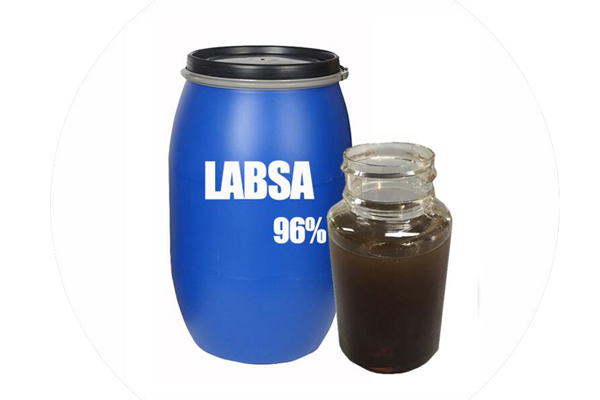
• Product Name: Linear Alkylbenzene Sulfonic Acid (LABSA) 96%
  • Other Name: DBSA, DDBSA, Sulfonic acid
  • Appearance: Brown viscous liquid
  • Active Matter (%): ≥96%
  • CAS No.: 85536-14-7
  • HS Code: 34021 100
  • MF: C18H30O3S

Linear Alkylbenzene Sulfonic Acid (LABSA) is also known as sulfonic acid, dodecyl benzene sulphonic acid (DBSA) or DDBSA. LABSA chemical is an organic weak acid with certain corrosiveness, especially strong irritation to skin and eyes. It is easily soluble in water and heats up when diluted with water. But LABSA is insoluble in general organic solvents.

LABSA chemical is one of the most widely used anionic surfactant raw materials. With an active matter content of 96%, LABSA provides excellent detergency, high foaming capability, strong wetting performance, and outstanding emulsification properties. So LABSA 96% can be used as washing raw material, such as washing powder, shampoo, shower gel, dishwashing liquid and combination soap, tableware cleaner and toilet cleaner.

ItemsLinear Alkylbenzene Sulfonic Acid (LABSA)
Appearance (25℃)Brown viscous liquid
Active Matter (%)≥96
Free Oil (%)≤2.0
Sulphate(%)≤1.5
Color (5% Am.aq.sol.) Klett≤50
PackingNet 220kg /plastic drum (FCL=17.6Mt)
Net 215kg /plastic drum (FCL=17.2Mt)
Storage and TransportStore labsa in dry and cool place, kept away from sunshine and rain.

Main Uses of Linear Alkylbenzene Sulfonic Acid (LABSA) 96%

1. Detergent Raw Materials. LABSA 96 is one of the main raw materials for producing detergent products such as washing powder, liquid detergent, shampoo, shower gel, dishwashing liquid, etc. Due to its excellent washing, emulsifying and foaming properties, it can effectively remove grease and dirt and improve the washing effect.

2. Textile industry. Used as a textile auxiliaries to improve the surface properties of fabrics, such as softness, hydrophilicity and antistatic properties. It can also be used as a scouring agent to help remove natural oils and impurities on fabrics, improving the quality and appearance of fabrics.

3. Electroplating industry. During the electroplating process, LABSA 96 can be used as a degreasing agent to remove oil and impurities from the metal surface to ensure the uniformity and quality of the electroplated layer.

4. Leather manufacturing. The sulfonic acid 96 can be used to remove grease and stains from the leather surface to improve the cleanliness and quality of the leather.

5.Papermaking industry. 96% linear alkylbenzene sulfonic acid can be used as a deinking agent to help remove ink and pigments from waste paper and achieve recycling of waste paper.

6. Other uses. In addition, LABSA 96 can also be used as an emulsifier, dispersant or stabilizer in the pesticide, pharmaceutical, cosmetics and other industries.
labsa 96 uses

(1) Detergency. Due to its surface active properties, linear alkylbenzene sulfonic acid 96 exhibits strong detergency and is suitable for the formulation of various detergents.

(2) Emulsification and dispersion properties. LABSA chemical can effectively mix oil and water to form a stable emulsion, enhancing the emulsification and dispersion effects of detergents.

(3) Foaming property. This chemical can produce rich and delicate foam to enhance the washing experience.

(4) Stability. LABSA 96% has good storage stability at room temperature and is not easy to decompose or deteriorate, which provides a guarantee for its long-term storage and transportation.

(5) Safety. Although it is irritating to the skin and eyes, safety risks can be effectively avoided by wearing protective clothing, gloves and glasses and other appropriate protective measures.

(6) Environmental performance. Sulfonic acid 96% is a biodegradable substance, which is conducive to reducing pollution to the environment and meets modern environmental protection requirements.

Chemical Nature and Structure

LABSA (Linear Alkylbenzene Sulfonic Acid) is an acidic anionic surfactant intermediate that must be neutralized with alkali (such as NaOH) before use. It contains no ethoxylation. In contrast, SLES 70% ( Sodium Lauryl Ether Sulfate) is a fully neutralized anionic surfactant with ethoxylated chains (EO), which significantly improves its solubility, mildness, and foaming characteristics.

Appearance and Physical Properties

LABSA is a brown, viscous, highly acidic liquid, while SLES 70% is a colorless to pale-yellow viscous liquid with weak acidity to near-neutral pH. These differences make SLES more suitable for personal-care formulations requiring mildness and stable pH.

Foaming Performance and Mildness

SLES 70% produces richer, finer, and more stable foam, and its ethoxylated structure greatly reduces irritation to skin and eyes. LABSA is harsher, offering strong detergency but higher irritation, and typically requires blending with milder surfactants to optimize user experience.

Application Differences

LABSA is widely used in heavy-duty detergents such as laundry powders, dishwashing liquids, industrial cleaners, and household detergents due to its high detergency and cost-effectiveness. SLES 70% is preferred for shampoos, body washes, hand soaps, face cleansers, and household liquid detergents where mildness and foam quality are essential.

Processing Requirements

LABSA must undergo neutralization, pH adjustment, and dilution before incorporation into formulations. SLES 70% is a ready-to-use, easily dilutable surfactant, simplifying production in personal-care and household liquid detergent manufacturing.


Hazards. LABSA chemical is a corrosive, strong acid that can cause severe skin and eye irritation or burns upon contact. Inhalation of vapors or mists may irritate the respiratory system and should be avoided.

Personal Protective Equipment. When handling sulfonic acid, operators should wear acid-resistant gloves, suitable protective clothing, and safety goggles or a face shield to prevent accidental splashes. In areas with poor ventilation, appropriate respiratory protection is recommended to minimize inhalation exposure.

Environmental Precautions. LABSA linear alkylbenzene sulfonic acid must be kept away from waterways and natural environments, as accidental discharge may cause ecological harm. Any wastewater containing LABSA should be properly neutralized before disposal, and all handling and discharge practices must comply with applicable local environmental regulations.

First Aid Measures. In the event of skin contact, wash the affected area thoroughly with plenty of water and seek medical attention if irritation persists. If the product enters the eyes, rinse immediately with clean water for at least fifteen minutes and obtain medical assistance. If ingested, do not induce vomiting; seek immediate medical attention and provide the product label or safety data information to healthcare personnel.

Packaging Options: LABSA chemical is commonly supplied in 200 L steel drums, 1000 L IBC tanks, and flexi-tanks or bulk liquid tankers. Customized packaging solutions can also be provided according to specific customer requirements.

Storage Conditions: The product should be stored in a dry, cool, and well-ventilated environment. It must be kept away from direct sunlight and high temperatures, and should not be stored near strong alkalis, oxidizing agents, or food materials to prevent adverse reactions or contamination.

Shelf Life: Under recommended storage conditions, LABSA 96% typically has a shelf life of 6–12 months, during which its performance and stability remain optimal.

Why Choose Fengbai Company

  • A leading supplier and exporter of LABSA chemical in China.
  • Stable supply & fast delivery.
  • Free samples for testing.
  • Various packaging to meet customers’ requirements.
  • ISO quality, good service and competitive LABSA price.
  • Good cooperation with cargo agents and shipping companies.

contact