
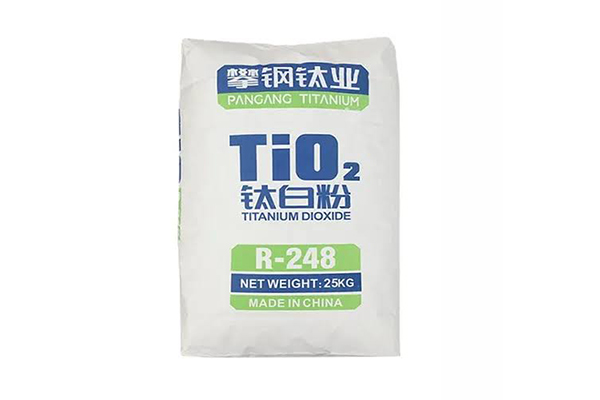
Pangang titanium dioxide R-248 is a sulfate-process rutile pigment primarily designed for plastic processing and masterbatch production. It features ZrO₂ and Al₂O₃ inorganic coatings combined with organic surface treatment to support compatibility with different resin systems.
With its bluish undertone, low oil absorption, and good dispersibility, R-248 helps achieve clean white shades and consistent coloring. It is suitable for PE and PP masterbatches, PVC products, plastic films, and other plastic applications.
Technical Specifications of Titanium Dioxide R-248
| Technical Parameters | Standard | Typical Value |
|---|---|---|
| TiO₂ Content (%) | ≥95.0 | 96.5 |
| Rutile Content (%) | ≥96.0 | 97 |
| Brightness (%) | ≥94.2 | 94.9 |
| L* Value (Dry Powder) | ≥97.2 | 97.4 |
| b* Value (Dry Powder) | ≤2.8 | 2.6 |
| Tint Reducing Power (Reynolds Number) | ≥1850 | 1890 |
| Dispersibility (Hegman) | ≥5.75 | 6.5 |
| Oil Absorption (g/100g) | ≤19 | 15 |
| Slurry pH | 6.0–9.0 | 7.5 |
| Electric Resistivity (Ω·m) | ≥60 | 120 |
| Volatile Matter at 105°C (%) | ≤0.8 | 0.2 |
| Sieve Residue (45 μm) (%) | ≤0.02 | 0.01 |
| Average Particle Size (nm, SEM) | — | 210 |
| Inorganic Treatment | ZrO₂, Al₂O₃ | — |
| Organic Treatment | Yes | — |
Recommended Uses of Pangang R-248
(1) Plastic Masterbatch Production. Titanium dioxide R-248 is suitable for manufacturing white masterbatches and other concentrated pigment preparations. Its low oil absorption and good dispersibility help facilitate pigment incorporation into carrier resins such as PE and PP. It also supports the production of masterbatches with consistent whiteness and color distribution.
(2) PVC Pipes and Fittings. In rigid PVC formulations, R-248 can improve product whiteness and opacity. It is suitable for PVC pipes, fittings, profiles, and related extruded products where stable color appearance and processing compatibility are required.
(3) Plastic Films and Calendered Products. For calendered plastic films and other sheet materials, R-248 provides pigment coverage and helps maintain a uniform visual appearance. Its dispersion characteristics are useful in applications where visible pigment particles or uneven coloration may affect finished product quality.
(4) Engineering Plastics. Manufacturers can use R-248 in selected engineering plastic formulations to achieve controlled coloration and a consistent surface appearance. Its pigment characteristics support various resin systems, although performance depends on resin compatibility and processing conditions.
(5) Powder Coatings. In suitable powder coating formulations, Pangang titanium dioxide R-248 can serve as a white pigment to provide opacity and color adjustment. Formulation testing is recommended to determine its compatibility with the resin system and required coating performance.
Selecting R-248 titanium dioxide for plastic production involves more than evaluating whiteness. Pigment loading, carrier resin compatibility, processing temperature, and dispersion quality can all influence the final product.
R-248 offers several practical advantages:
– Suitable for concentrated pigment formulations: Its relatively low oil absorption helps reduce carrier requirements during pigment incorporation.
– Supports precise color adjustment: The bluish undertone provides flexibility when developing white and customized color formulations.
– Designed for polymer applications: Its inorganic and organic surface treatments are tailored to plastic processing requirements.
– Good pigment distribution: Its dispersibility characteristics help manufacturers achieve a more uniform appearance in finished products.
– Multiple processing options: It can be evaluated for extrusion, compounding, calendering, and other plastic manufacturing processes.